
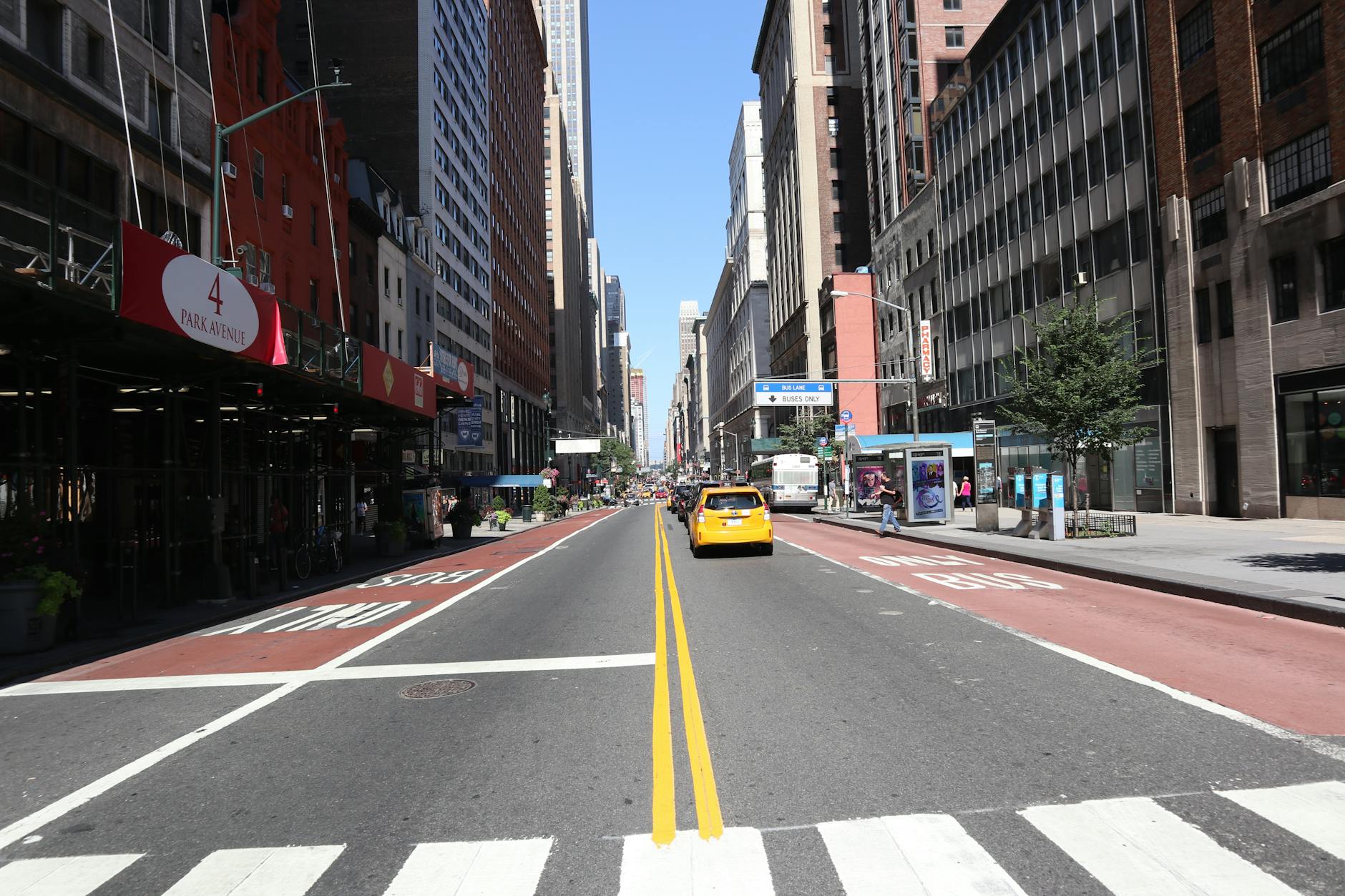
Construction crews will return to Flatbush Avenue later this month, picking up work on a bus lane project that’s been years in the making and could finally give Brooklyn’s most congested transit corridor something it hasn’t had in a long time: speed.
The city Department of Transportation plans to resume work during the last week of April, continuing installation of center-running bus lanes along Flatbush Avenue between Livingston Street and Grand Army Plaza. DOT broke ground on the stretch between Livingston and State Streets last fall, then had to pause when winter weather made the work impractical. Spring’s here. So is the backhoe.
The redesign is a serious undertaking. Beyond the bus lanes themselves, the project includes six concrete boarding islands where riders wait to get on, nearly 29,000 feet of new pedestrian space, eleven dedicated loading zones, and 14 bike parking areas. Construction is expected to run through the summer and into the fall, and DOT says it will proceed in four phases, reconstructing one side of the street at a time so two-way vehicle traffic can continue on the other.
None of this is coming a moment too soon for the 132,000 daily riders who depend on buses on this corridor.
Bus speeds on Flatbush Avenue can crawl to four miles per hour. Four. A brisk walker covers ground at roughly three and a half. DOT Commissioner Mike Flynn put it plainly: “Often be as fast to walk as it is to take a bus on Flatbush Avenue, and with over 100,000 riders relying on the bus to get around, that must change.” A 2024 survey by advocacy group Riders Alliance found that 91% of riders experienced delays on the avenue in 2023. That’s not a bad run of luck. That’s a broken system.
The project will primarily serve the B41, one of the borough’s most heavily used routes, along with the B67, B69, B63, B45, and B103. The dedicated lanes will be enforced through both bus-mounted cameras operated by the MTA and stationary cameras run by DOT, which means drivers who try to use the lanes as a shortcut will get a bill in the mail.
Mayor Zohran Mamdani made clear this isn’t just an infrastructure decision. “These center-running bus lanes will give New Yorkers back something precious: time with their families, time at work, time in their communities,” he said in a statement. “Long waits and unreliable service are not inevitable. They are the result of political choices. Today, we are choosing a system that puts bus riders first and builds safer streets for everyone.”
The boarding islands are worth paying attention to. They move waiting riders onto a protected concrete platform rather than the curb lane, which changes the geometry of the street in ways that research consistently shows reduce pedestrian injuries. Riders Alliance Organizer Jolyse Race said it directly: “Dedicated lanes down the center of the spine of Brooklyn show us the respect and dignity we deserve.”
Not nothing.
The project was first floated by former Mayor Eric Adams’ administration back in 2022, which means it’s taken four years to get to the point where work can actually continue. That timeline reflects how hard it is to build anything in this city, even things with broad support from riders, safety advocates, and transit planners. Bureaucratic inertia is real, and Flatbush Avenue riders have been absorbing the cost of it every single morning.
Reporting from amNewYork first flagged the resumption timeline and the scope of what’s ahead this construction season.
For drivers, DOT is encouraging use of alternative routes, public transit, or simply budgeting extra travel time. The agency is working to keep two-way vehicle traffic moving throughout the build, but a project this size, spanning multiple phases across a major Brooklyn artery, will create friction. That’s the cost of fixing something that’s been broken for years.
The New York City Department of Transportation has seen these corridor redesigns succeed elsewhere in the borough, and the data on center-running bus lanes is consistent: they work. Buses move faster. Riders show up on time. Streets get safer.
Flatbush Avenue moves people from downtown Brooklyn all the way up to Prospect Park and beyond. It’s the spine of the borough, as Race put it, and right now it runs at a pace that would embarrass a slow jogger. Come fall, if the timeline holds, that should look considerably different.